

 Facebook
 X
 Pinterest
 Copy Link
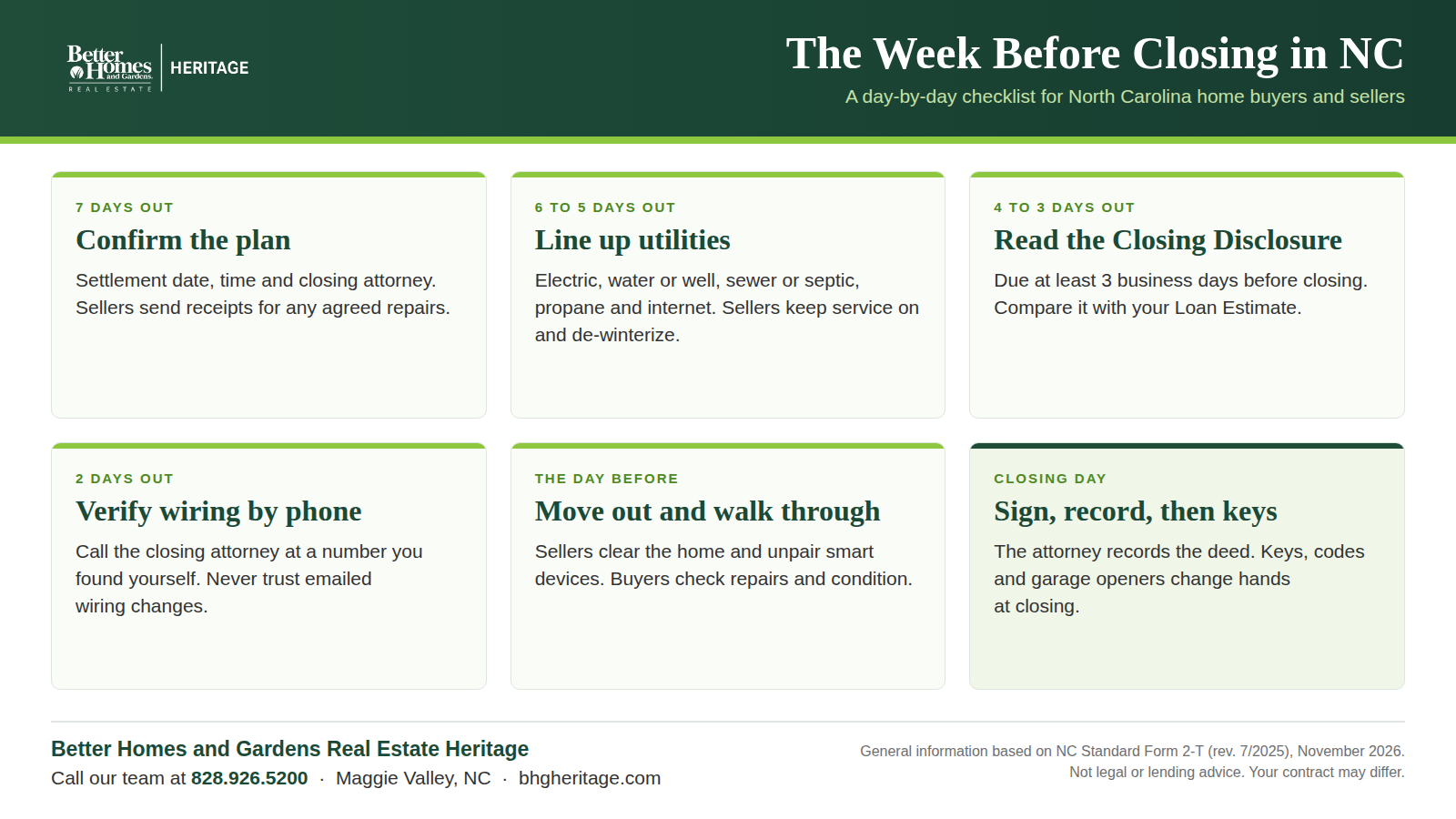
The week before closing in NC is when a home purchase turns from paperwork into keys. Due diligence is over and the loan is nearly final. Still, a few steps in those last seven days decide whether closing day is smooth or stressful.
This day-by-day checklist for buyers and sellers is based on the current North Carolina standard offer form (Form 2-T, revised July 2025) and on what our team at Better Homes and Gardens Real Estate Heritage, based in Maggie Valley, sees at closings across Haywood County and Western North Carolina.
The week before closing in NC at a glance
- 7 days out: confirm the settlement date, time and closing attorney. Ask for receipts for any agreed repairs.
- 6 to 5 days out: transfer or set up electric, water, sewer, propane, trash and internet.
- 4 to 3 days out: read your Closing Disclosure. Lenders must get it to you at least three business days before closing.
- 2 days out: confirm wiring instructions by phone with the closing attorney, using a number you found yourself.
- The day before: sellers move out, clear debris and unpair smart devices. Buyers do the final walk-through.
- Closing day: sign, the attorney records the deed with the county, and the keys change hands.
Settlement and closing are two different steps
North Carolina’s standard contract uses two words people often mix up. Settlement is the signing, when the closing attorney receives the documents and funds. Closing comes after: the attorney updates the title, gets authorization to pay out the money and records the deed.
In Haywood County, deeds are recorded at the Haywood County Register of Deeds in Waynesville. Under the standard form, the buyer gets possession at Closing, after recording, unless the parties signed an early or late possession agreement. Plan the moving truck around recording.
Seven days out: confirm the plan
Confirm the settlement date and time with your agent. Then ask the closing attorney’s office whether they need anything else from you.
Next, check on repairs. If the buyer and seller agreed on repairs during due diligence, the standard form says the work must be done in a good and workmanlike manner. The buyer also has the right to verify it before settlement. Sellers, send your agent the contractors’ receipts now.
For a refresher on how you got here, read what happens after you go under contract in North Carolina.
Utilities in the week before closing in NC
Utilities take more sorting out in the mountains. One Haywood County address might get electric from Duke Energy, Haywood EMC or the Town of Waynesville. Water and sewer might come from a town, from a district such as Maggie Valley Sanitary District or Junaluska Sanitary District, or from a private well and septic system. Not sure which applies? Our guide to living inside vs. outside town limits in Haywood County explains the difference.
Sellers should keep the utilities on until closing. The standard form requires the seller to provide existing utilities, at the seller’s cost, through closing or possession, and that includes de-winterizing a vacation home that was shut down for the season. That matters in November and December, when many mountain cabins are drained. Buyers, ask the providers to start service in your name on closing day.
Propane needs its own call. An owned tank conveys with the home, along with any fuel left in it at settlement. A leased tank does not, and NC law bars anyone but the supplier or the tank’s owner from filling or disconnecting it without the supplier’s consent. If the tank is leased, call that company to open your own account.
Read your Closing Disclosure
If you have a mortgage, your lender must give you a Closing Disclosure at least three business days before closing, according to the Consumer Financial Protection Bureau. For this rule, Saturdays count as business days, but Sundays and federal holidays do not. For example, a closing on Monday, November 30, 2026 needs the disclosure in hand by Wednesday, November 25, because Thanksgiving and Sunday don’t count.
Compare it with your Loan Estimate: loan amount, rate, monthly payment and cash to close. If something looks off, call your lender that day. For a rundown of what buyers typically pay, see what it really costs to buy a home in Western North Carolina.
Also, keep your finances quiet. Lenders often re-check credit and employment right before funding, so a new car loan or a job change can delay closing.
Protect your money from wire fraud
Wire fraud is one of the most serious money risks in the week before closing in NC. Criminals hack email accounts and send fake wiring instructions that look like they came from the attorney, the lender or the agent. The NC Real Estate Commission has reported on cases where buyers lost their savings this way, in its bulletin When Hackers Strike.
The standard NC contract includes its own wire fraud warning. In plain terms:
- Before you wire money, call the closing attorney’s office and confirm the instructions.
- Find that phone number yourself. Don’t use a number from an email, even one that seems to come from your agent.
- If you get new instructions for a different bank or account, treat them as fake and call the attorney again.
- Sellers should give their own wiring instructions in writing at settlement, in front of the attorney.
Wiring instructions should come straight from the closing attorney to you. If your agent or anyone else emails you instructions, don’t send money. Call the attorney first.
Sellers: move out, clean out and unpair

Sellers must remove their belongings and debris by the time the buyer takes possession.
By the time the buyer takes possession, the seller must remove all personal property that isn’t part of the sale, plus garbage and debris. An old couch left in the basement can turn a friendly walk-through into a tense one.
Fixtures stay unless the contract excludes them, from light fixtures and ceiling fans to wood stoves, well pumps and storage sheds. If you remove an excluded item, you must repair any damage it leaves.
The current form also covers smart homes. Before closing, sellers should unpair smart thermostats, doorbells, cameras and locks, delete personal data and reset them to factory settings. Then gather every key, code and remote in one place. And keep your homeowners insurance in force: the contract advises sellers not to cancel it until the deed is recorded.
The final walk-through in the week before closing in NC
The standard contract gives buyers the right to a final walk-through. Most buyers schedule it a day or two before settlement, after the seller moves out.
Use the walk-through to confirm three things. First, the agreed repairs are done. Second, the items that convey are still there. Third, the home is in substantially the same or better condition than on the offer date, apart from normal wear and tear.
Bring your agent and a short list:
- Run the faucets, flush the toilets and look under the sinks.
- Turn on the heat, the water heater and every appliance that conveys.
- Open the garage door with the remote and test the door codes.
- Walk the outside, including the driveway, decks and any outbuildings.
- Check the crawl space or basement for water after recent rain.
If you find a problem, tell your agent right away. Many issues get worked out before settlement with a repair, a credit or a short delay.
Mountain roads add one more planning step. If snow or ice is in the forecast, book the walk-through a day early rather than the morning of closing.
Closing day: sign, record, then keys

Under the standard NC contract, keys, codes and openers change hands at closing.
Bring a photo ID and your funds in the form the attorney asked for. After everyone signs, the attorney updates the title and records the deed. Then possession passes, and the standard form says that means every way in: keys, mailbox keys, security codes, garage door openers and electronic devices.
Then the next list starts. Our first 30 days after closing checklist picks up right where this one ends.
Week before closing in NC: frequently asked questions
How many days before closing do I get the Closing Disclosure?
At least three business days before closing. For this rule, Saturdays count but Sundays and federal holidays do not. Read it the day it arrives so there is time to fix errors.
When do buyers get the keys in North Carolina?
At Closing, which under the standard form means after the deed is recorded. A signed early or late possession agreement can change that timing.
Does the seller have to leave the propane in the tank?
If the seller owns the tank, the tank and any fuel left at settlement convey with the home. A leased tank does not convey, so the buyer sets up an account with the tank’s owner.
What if something breaks during the week before closing?
The seller carries the risk of loss until closing, and the home must be in substantially the same or better condition, apart from normal wear and tear. Tell your agent right away so there is time to work it out.
Ready for your closing week? Our team can help
Better Homes and Gardens Real Estate Heritage, based in Maggie Valley, helps buyers and sellers across Haywood County and Western North Carolina get to the closing table. Need a contractor or inspector? Start with our local vendor resources. Not sure who handles what? Read who to call when buying a home in NC. Still looking? You can search homes by location and budget.
Have questions about the week before closing in NC? Reach out to one of our team at Better Homes and Gardens Real Estate Heritage. Call us at 828.926.5200 and we’ll connect you with an agent who knows Haywood County.
This article is general information for buyers and sellers, current as of November 2026 and based on NC REALTORS® Standard Form 2-T (revised 7/2025). Your contract may differ. It is not legal or lending advice; ask your closing attorney and lender about your transaction. Information deemed reliable but not guaranteed.


