

 Facebook
 X
 Pinterest
 Copy Link
Knowing who to call when buying a home in NC saves you time, money and a lot of guesswork. Your real estate agent is your main contact from first showing to closing day. Still, some questions belong to a licensed inspector, engineer, surveyor, attorney, lender or insurance agent.
That matters even more in the mountains of Western North Carolina. Homes in Haywood County often sit on steep lots, run on a private well and septic system, and come with older deeds or private roads. Your agent can spot those issues. However, the answers should come from someone licensed to give them.
Here is who does what, and when to bring each one in.
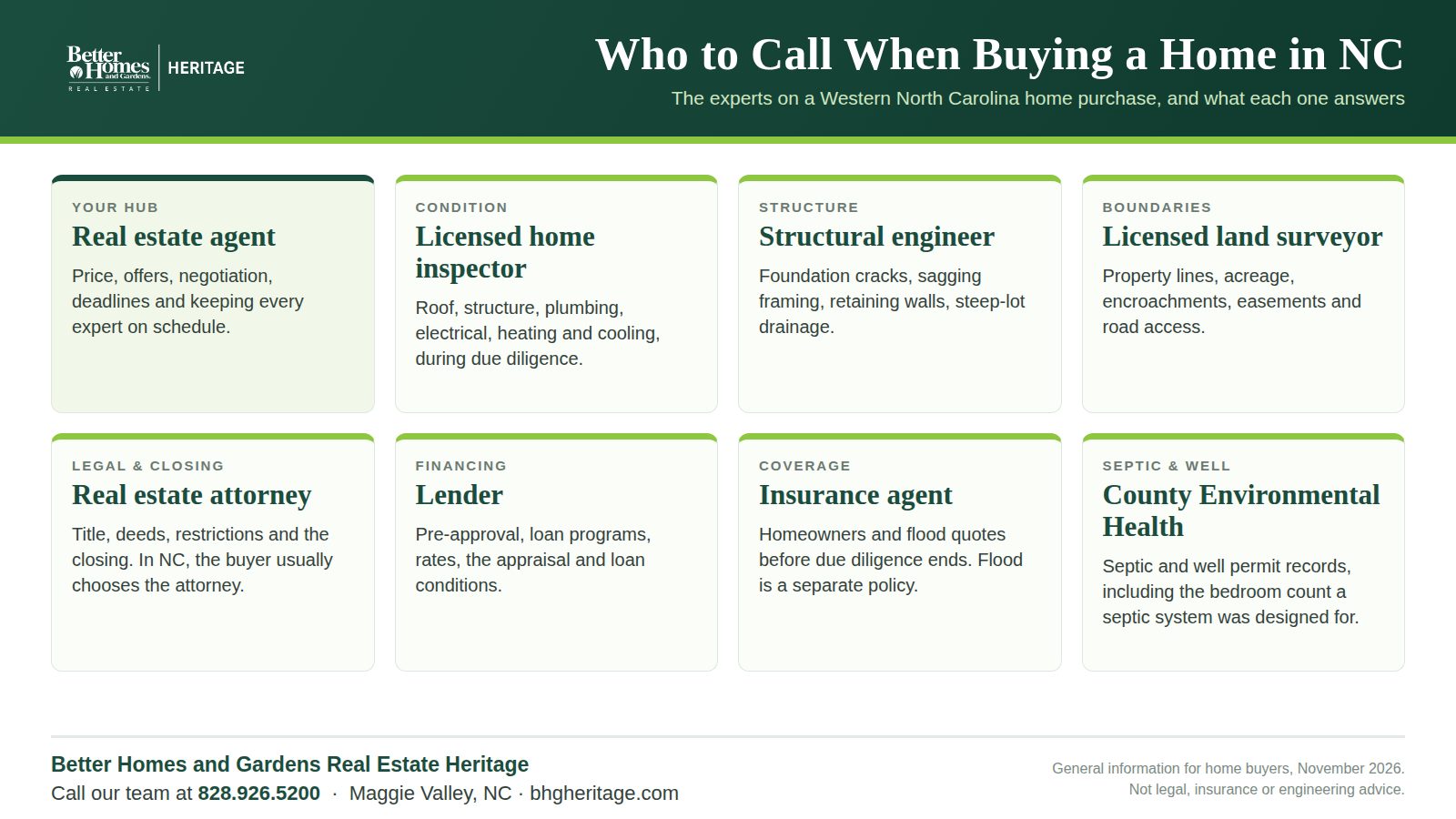
Who to call when buying a home in NC: at a glance
- Real estate agent: price, offers, negotiation, deadlines and keeping everyone on schedule.
- Licensed home inspector: the condition of the house, from the roof to the crawl space.
- Structural engineer: foundation cracks, sagging framing, retaining walls and steep-slope concerns.
- Licensed land surveyor: boundaries, acreage, encroachments and easements.
- Real estate attorney: title, deeds, legal questions and the closing. In North Carolina, the buyer usually chooses the closing attorney.
- Lender: pre-approval, loan programs, rates, the appraisal and loan conditions.
- Insurance agent: homeowners and flood insurance quotes before your due diligence period ends.
- Haywood County Environmental Health: permit records for the septic system and the well.
Your first call when buying a home in NC: a real estate agent
Your agent is the hub of the deal. A good agent helps you set a price strategy, writes and negotiates the offer, and tracks the due diligence deadline. They also keep the lender, inspector and attorney moving toward the same closing date.
An agent knows the area, too. They can tell you what similar homes sold for, which roads are steep in winter, and what to ask about a shared driveway.
But agents have limits. A real estate agent is not a building expert, a surveyor or a lawyer. When your question needs a license your agent doesn’t hold, the right answer is “let’s get the expert.” Our team keeps a list of local vendor resources for exactly that reason.
Every real estate office in North Carolina also has a broker-in-charge who supervises the firm. If something about your purchase doesn’t feel right, you can ask to talk with that person.
Home inspector: what condition is the house in?
North Carolina licenses home inspectors through the Home Inspector Licensure Board, part of the NC Office of State Fire Marshal. The board’s site has a directory where you can look up an inspector’s license.
The inspection happens during your due diligence period. The inspector checks the roof, structure, plumbing, electrical system, heating and cooling, and more, and then writes a report. Next, your agent helps you sort the report into what matters and what to ask the seller to fix. For the full timeline, read what happens after you go under contract in North Carolina.
Common add-ons in the mountains include a wood-destroying insect report, radon testing, well-water testing and a septic inspection. Ask your inspector which ones they offer and which ones need a separate company.
Structural engineer: when the report says “further evaluation”
Inspectors often recommend that a specialist take a closer look. When the concern is structural, that specialist is usually a licensed engineer.
Call an engineer when you see:
- Cracks in the foundation or block walls
- Sloping floors or sagging beams
- A leaning or failing retaining wall
- Signs of soil movement or drainage trouble on a steep lot
These questions come up more often on a hillside than on flat ground. An engineer’s letter tells you what the problem is and what a fix could involve. As a result, your agent has something solid to negotiate with.
Land surveyor: where are the property lines?
A survey shows the boundaries, the acreage and anything that crosses a line, such as a fence, a driveway or a shed. It can also show easements and how the property reaches the road.
Older mountain deeds sometimes describe boundaries by trees, rocks or fence lines that have changed over the years. A new survey is the way to know exactly what you are buying. It matters most for land and acreage, so read buying land in Haywood County: is it buildable? before you make an offer on a lot.
Your agent can point out a fence that looks off. Only a licensed surveyor can tell you where the line really is.
Buying a home in NC? Call an attorney about title, deeds and closing
In North Carolina, attorneys handle most real estate closings. The NC Real Estate Commission’s guide to real estate closings says your closing will probably be handled by an attorney you choose. Others may recommend one, but you have the final word.
The closing attorney examines the title, prepares and explains the documents, records the deed and pays out the funds. The same guide notes that one attorney may also represent the lender and the seller, so ask up front whom they represent.
Bring an attorney in early if you have questions about:
- Liens, title problems or a sale by an estate
- Deed restrictions, HOA rules or a road maintenance agreement
- How to take title, for example with a spouse, with family or in a trust
- What a contract term means for you legally
Your agent can explain how the standard contract works. Only an attorney can give you legal advice about it.
Lender: what can you afford, and will the loan close?
Talk to a lender before you start looking. A pre-approval sets your price range and shows sellers you are ready.
After you are under contract, the lender orders the appraisal, sets the loan conditions and sends your Closing Disclosure. Questions about rates, down payment, loan programs or a low appraisal go to the lender. Our mortgage info page is a good place to start. If rates are holding you back, read why you can still buy a home with 7% mortgage rates.
Insurance agent: an early call when buying a home in NC
Get a homeowners insurance quote early, while you can still walk away. The age of the roof, the heating system and the home’s distance from a fire station can all affect the price. A surprise premium is much easier to handle during due diligence than the week before closing.
Then check the flood risk. You can look up any address on the state’s NC Flood Risk Information System. If the home is in a high-risk flood zone and you are using a mortgage, your lender will require flood insurance. Hurricane Helene in September 2024 was also a reminder that a standard homeowners policy does not cover flood damage, so ask your insurance agent about flood coverage even outside a mapped zone.
County records: septic and well permits
Many homes outside town limits run on a private well and a septic system. Haywood County Environmental Health issues the permits for both, and those records can answer questions a listing can’t.
For example, the septic permit shows how many bedrooms the system was designed for. That can change how a home is marketed, as we explained in why a home may have four bedrooms but be advertised differently. Not sure whether a home is on town water and sewer? See living inside vs. outside town limits in Haywood County.
Who to call when buying a home in NC: FAQ
Do I need a real estate attorney to buy a house in North Carolina?
In nearly every case, yes. North Carolina closings are handled by attorneys, and the buyer usually picks the closing attorney. You can also hire an attorney earlier for title or contract questions.
Can my real estate agent tell me if a foundation crack is serious?
No. Your agent can point it out and help you get it checked, but a licensed home inspector or structural engineer should judge it. Your agent then uses their findings to negotiate with the seller.
When should I get a survey in Western NC?
Order it during your due diligence period so you can still act on what it shows. It matters most for land, acreage, homes reached by a private road and homes with fences or driveways near a line.
Who chooses the closing attorney, the buyer or the seller?
Usually the buyer. The NC Real Estate Commission says you have the final word, even if someone recommends an attorney. Because one attorney may also represent the lender and seller, ask whom they represent.
When should I get homeowners insurance quotes?
Early in due diligence. Then update the quote after the inspection, because details like the roof’s age can change the price.
Need a name? Start with our team
Better Homes and Gardens Real Estate Heritage, based in Maggie Valley, helps buyers across Haywood County and Western North Carolina line up the right inspectors, surveyors, attorneys, lenders and insurance agents. To plan your budget, read what it really costs to buy a home in Western North Carolina and the hidden costs of buying a mountain home. When you are ready, you can search homes by location and budget.
Not sure who to call when buying a home in NC? Reach out to one of our team at Better Homes and Gardens Real Estate Heritage. Call us at 828.926.5200 and we’ll connect you with an agent who knows Haywood County.
This article is general information for home buyers, current as of November 2026. It is not legal, insurance or engineering advice. Information deemed reliable but not guaranteed.


