

 Facebook
 X
 Pinterest
 Copy Link
A Haywood County flood zone can sit right beside some of the prettiest home sites in Western North Carolina. Creeks and rivers run through almost every valley here, from the Pigeon River in Canton and Clyde to Jonathan Creek in Maggie Valley and Richland Creek in Waynesville. Plenty of buyers want to live near that water.
Since Tropical Storm Fred in August 2021 and Hurricane Helene in September 2024, those same buyers ask a harder question. Will this house flood?
You can answer most of that before you make an offer. This guide from Better Homes and Gardens Real Estate Heritage, based in Maggie Valley, covers the maps, the seller disclosure, flood insurance and the local permits that matter when you buy near water in Haywood County, North Carolina.
Haywood County flood zone facts at a glance
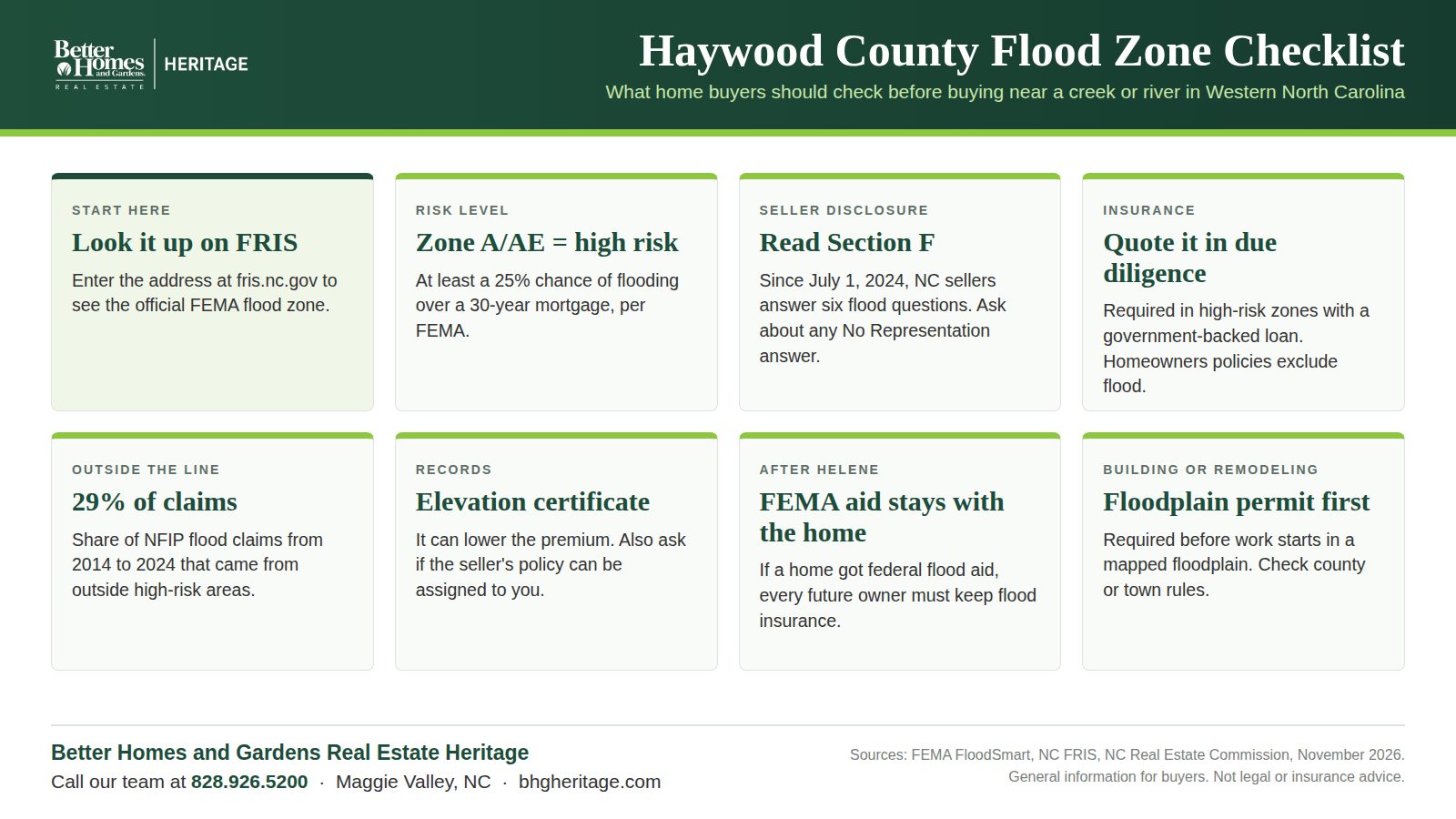
- Any North Carolina address can be looked up for free in the state’s Flood Risk Information System (FRIS), which shows the official flood zone.
- High-risk flood areas (A and V zones on FEMA maps) have at least a 25% chance of flooding during a 30-year mortgage, according to FEMA (checked November 2026).
- A home in a high-risk zone that is bought with a government-backed mortgage must carry flood insurance.
- From 2014 to 2024, 29% of National Flood Insurance Program (NFIP) claims came from outside high-risk flood areas, per FEMA.
- Since July 1, 2024, the North Carolina seller disclosure form asks six flood questions, including past flood damage, insurance claims and FEMA aid.
- A new NFIP policy usually takes 30 days to start. There is no wait when you buy it with a new mortgage.
- Standard homeowners insurance does not cover flood damage.
How to check a Haywood County flood zone before you make an offer
Start with the map. Type the address into FRIS, North Carolina’s Flood Risk Information System. It shows the flood zone, the floodplain boundary and, for many properties, flood risk details and estimated insurance costs.
Reading the result:
- Zone A or AE: high risk. This is the Special Flood Hazard Area that lenders care about.
- Shaded Zone X: moderate risk, often just outside the high-risk line.
- Unshaded Zone X: lower risk, but not zero.
Next, look at where the house sits on the lot, not just the lot itself. In the mountains, a parcel can touch a creek while the house sits well above it. On the other hand, a home outside the mapped zone can still take water from a hillside, a culvert or a road that drains toward it.
Flood maps also change. North Carolina updates its flood studies county by county, so ask your agent whether a new map is proposed for the area.
What the NC seller disclosure tells you about flooding
North Carolina sellers fill out the Residential Property and Owners’ Association Disclosure Statement before you make an offer. Since July 1, 2024, Section F of the NC Real Estate Commission form asks whether:
- the property is in a federal or other designated flood hazard zone
- it has had damage from flooding, water seepage or pooled water from a natural event
- the owner ever filed a flood damage claim, including with the NFIP
- there is a current flood insurance policy
- the owner received FEMA, SBA or other federal flood assistance
- there is a flood or FEMA elevation certificate
Each answer is Yes, No, No Representation (NR) or Not Applicable. Pay attention to NR. It can mean the owner doesn’t know, or that the owner knows and chooses not to say. Either way, it’s a reason to ask more questions and order your own inspections.
Flood insurance for a Haywood County flood zone home
If the home is in a high-risk zone and your loan is government-backed, your lender will require flood insurance. Ask your lender early whether they will require a policy on the home you want.
FEMA’s FloodSmart site explains how NFIP pricing works. Three things set the rate: where the home is, how it’s built and what it would cost to rebuild. Every NFIP agent charges the same rate for the same home, so you don’t need to shop that part around. A homeowner policy covers up to $250,000 for the building and up to $100,000 for belongings.
A few things can lower the cost or save you trouble:
- Ask whether the seller’s current policy can be assigned to you. The NC disclosure form notes that an existing policy may cost less than a new one.
- Ask for the elevation certificate. If there isn’t one, a licensed surveyor can prepare it, and it may lower the price.
- A water heater or electrical panel raised above flood level may also lower the price.
Get your quote during due diligence, not the week before closing. Our post on what happens after you go under contract in North Carolina explains why that window matters.
Homes that flooded or received FEMA aid after Helene
Some homes along the Pigeon River and other creeks were damaged in 2024 and later repaired. Many are solid homes today. Still, a few rules follow these properties.
First, if a property received federal disaster assistance, the requirement to carry flood insurance passes to every future owner. If an owner drops it, that owner can lose eligibility for future aid.
Second, after Helene, Haywood County and the towns of Canton and Clyde made “substantial damage” decisions on flooded buildings. Under NFIP rules, when repairs reach 50% of a building’s market value, the building must meet current floodplain standards, which often means raising it. Ask the seller for any letters from the town or county, along with permits for the repairs.
Haywood County also runs a voluntary hazard mitigation program that can buy out, raise or rebuild flood-prone homes. Bought-out lots become permanent open space, so a neighboring lot may never be built on.
Building or remodeling in a Haywood County flood zone
Planning an addition, a garage or a new home near a creek? A floodplain development permit is required before work starts in a mapped floodplain. Haywood County Development Services handles floodplain permits in the county’s jurisdiction. Towns such as Waynesville have their own floodplain rules, so check which office covers the address.
Our guides to whether a Haywood County lot is buildable and living inside vs. outside town limits go into more detail on who permits what.
Questions to ask when you tour a home near water
Walk the property with these questions in mind:
- Are there water lines, mud or debris marks in the crawl space, basement or garage?
- Is the heating and cooling equipment or ductwork low in a crawl space?
- Does the driveway cross a bridge or culvert, and who maintains it?
- Did the road wash out in 2021 or 2024, and how long was access cut off?
- Is there a sump pump, a French drain or regrading around the house?
A home inspector, a surveyor and an insurance agent each answer a different piece of this. Our list of who to call when buying a home in NC shows who does what. For more costs that surprise mountain buyers, see the hidden costs of buying a mountain home, and our local vendor resources page lists trusted pros.
Haywood County flood zone FAQ
How do I find out if a house is in a flood zone in Haywood County?
Enter the address in FRIS at fris.nc.gov. It shows the official FEMA flood zone for the property. Then compare that with the seller’s answers in Section F of the disclosure form.
Do I need flood insurance if the home isn’t in a flood zone?
Your lender may not require it, but FEMA reports that 29% of NFIP claims from 2014 to 2024 came from outside high-risk areas. Policies outside the high-risk zone usually cost less. Get a quote and decide with the numbers in front of you.
Can I buy flood insurance right before closing?
Yes, when it’s tied to your new mortgage. In that case FEMA applies no 30-day wait. However, get your quote early in due diligence so the cost doesn’t surprise you.
Does a seller have to tell me if the house flooded?
The NC disclosure form asks about past flood damage, claims and FEMA aid. A seller can answer No Representation, though, and real estate brokers must still disclose material facts they know about. Ask direct questions and order your own inspections.
Talk with a local team before you buy near water
A creekside home in the mountains can be a great buy when you know the risk and the cost up front. Want help checking a property’s flood zone, insurance and permits? Search homes by location and budget, then reach out to one of our team at Better Homes and Gardens Real Estate Heritage. Call us at 828.926.5200 and we’ll connect you with an agent who knows Haywood County.
General information for home buyers, current as of November 2026. Not legal, insurance or engineering advice. Confirm flood zones, insurance and permits with FRIS, a licensed insurance agent and the local floodplain administrator.


